
When the budget is out of date: how seasoned CEOs use a rolling forecast instead
Updated: Sep 22
It’s nearly August, and saying the Australian economy isn’t thriving is a bit of an understatement. Which makes it difficult for CEOs and boards to work out what the year ahead now looks like...
Sales timing has probably changed given the market has softened
Interest rates, fuel and staff costs are increasing
Recruitment plans are being pushed out due to costs
Revenue assumptions in your original budget no longer reflect the conversations happening with customers today.
Your organisation is still reporting against the approved budget, but you and your team are no longer managing the year that budget expected. If the CEO, executive team and board keep treating old assumptions as though they remain the best available view of what comes next, problems will surface.
When the annual budget no longer reflects reality, a rolling forecast helps CEOs ask better questions and make stronger decisions about changing revenue, costs, staffing and cash.
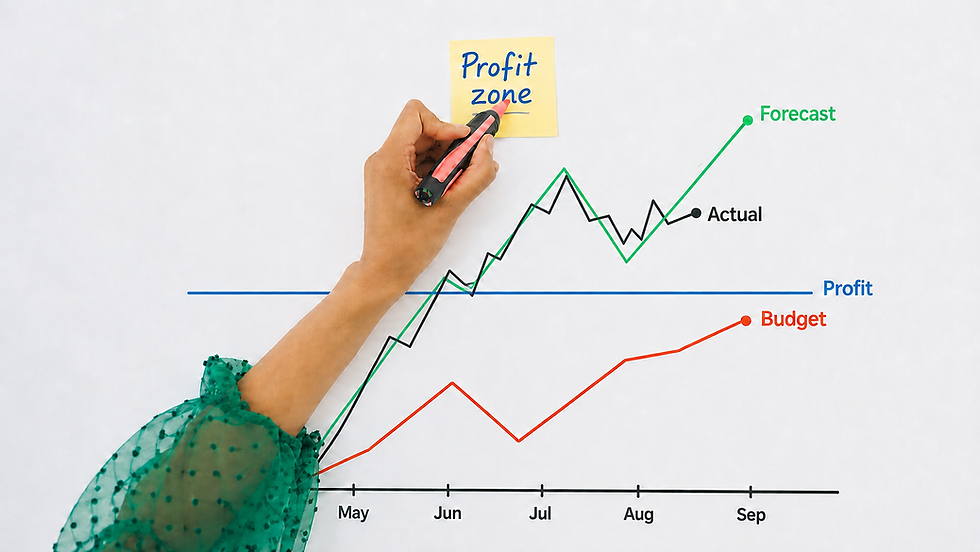
Keep the budget, but stop asking it to predict the future
A budget and a rolling forecast answer different questions, and an organisation needs both.
The budget sets the financial plan for the year. It records the revenue, costs, staffing, investment and cash assumptions that supported the organisation’s agreed priorities when the board approved them.
The budget is your agreed map. It shows the goals the organisation wants to achieve during the year and how leadership originally expected to reach them. It therefore remains an important reference point for accountability, performance and governance.
The rolling forecast starts from the same position as the original budget, but it is regularly updated using actual results, current information and revised assumptions. It shows the likely outcome from this point forward as sales conditions, staffing, supplier costs, project timing, funding or customer behaviour change.
That is where the term rolling comes from. The forecast continues to move with the organisation.
It is much like changing travel plans when a volcano, flood or another roadblock affects the route. The disruption doesn’t necessarily change the destination, but it does change the decisions required to get there.
Scenario planning goes one step further. It tests what the organisation could do under several plausible versions of the future, rather than relying on one expected result. it adds another layer by showing how the forecast changes under different assumptions, and shows what leadership might need to do if conditions improve or weaken.
TLDR:
The budget shows what leadership intended to achieve when the year was planned.
The rolling forecast shows where the organisation is now heading.
Scenario planning shows what leadership might do if conditions improve, weaken or move differently again.
Any large variance needs a decision, not a longer explanation
Many monthly reports explain variances - what happened against budget - but stop before showing what the change means for the rest of the year, or what decisions are needed to restore cash-flow or reduce risk.
Updating the rolling forecast does not erase the budget variance. It makes the likely end result visible early enough for leadership to take appropriate action.
In a well-run organisation, any large variance drives change; new decisions may be needed about the timing of a hire, the affordability of a project, the cash available for growth or the result expected at year end.
Revenue may be $250,000 behind because a customer contract started six weeks later than expected. The variance commentary may explain the delay, but the CEO still needs to know whether the revenue has moved into a later month, reduced permanently or created a cash gap affecting recruitment and supplier commitments.
An insurance renewal may be $40,000 above budget. That is useful to record, but leadership also needs to know whether other renewals are likely to follow, whether the cost can be absorbed and which planned spending may need to move.
For a not-for-profit, a grant payment may arrive later than expected while program costs continue on schedule. The annual funding may remain secure, but the timing gap can still place pressure on cash and require an early conversation with the board.
A large budget variance is therefore not only a reporting issue. At the very least, it should trigger new decisions that reduce risk and protect cash.
Assumption tests to help build your rolling forecast
To decide whether the organisation needs to create or update a rolling forecast, useful questions include:
Are sales still expected to close at the value and timing assumed in May?
Have customer decisions slowed, deal sizes changed or project starts moved?
Are wages, insurance, software, rent or supplier costs now running above the original assumptions?
Has recruitment moved forward, been delayed or become more expensive?
Are grants, donations, customer receipts or other funding arriving when the budget expected?
Are operational teams continuing to commit spending based on revenue that has not yet arrived?
Does the board see the latest expected full-year result, or only actual results against an old budget?
Can the CEO see the effect on cash, not only the effect on reported profit?
Are leaders debating whether the budget can still be achieved without agreeing which actions would make that possible?
Several “no” or “not sure” answers usually mean the organisation needs to move beyond using the budget and budget variances alone. It needs a rolling forecast, rather than another round of commentary explaining what has already happened.
A rolling forecast keeps allows a longer view at a high level
A rolling forecast maintains a consistent forward view by adding a new month or quarter as each reporting period closes. Instead of reaching December with only six months remaining in the annual budget, by using a rolling forecast leadership can continue to see the next eighteen months of expected revenue, costs, cash and commitments.
The forecast should remain a high-level snapshot, not become a second annual budgeting exercise. It needs enough detail to support decisions, while remaining focused on the assumptions that genuinely drive the result.
For most organisations, these are the business drivers to include:
Sales value, probability and expected start dates.
Customer retention, pricing changes and contract renewals.
Staffing numbers, start dates, salary changes and contractor use.
Supplier prices, software, insurance, rent and major operating costs.
Project delivery timing and the costs required before revenue is received.
Grant, donor or government funding timing and any spending restrictions.
Tax, debt, capital expenditure and other significant cash commitments.
The forecast becomes most useful when each assumption has an owner, and that owner monitors changes, and potential changes and drives updates. Sales leaders should stand behind the pipeline assumptions, operational leaders should confirm delivery and staffing needs, and finance should connect those assumptions to profit, cash and the commitments already made.
Build the forecast, then debating the target
A common forecasting mistake is to start with the approved budget and tweak it a bit while still preserving the original year-end result - which creates false comfort by hiding issues and delaying the decisions leadership may need to make.
Every forecast should provide the best honest view of actual results to date, current sales information, known cost changes and realistic timing.
Leadership should first ask: What is likely to happen if the organisation continues on its current path?
Once that is visible, leadership can then ask: What could improve the result?
A forecast is not pessimistic because it shows a weaker result than the budget. It is useful because it gives leadership time to choose a response:
Change activities
Change the target
or
Both
Scenario planning turns uncertainty into choices
A rolling forecast cannot answer every question when sales conditions, costs or funding remain uncertain. Scenario planning helps the CEO and board understand the range of plausible outcomes and agree what would trigger a different response.
A practical set of scenarios might include:
A base case using the most likely sales, cost and timing assumptions.
A downside case showing the effect of slower sales, delayed funding or higher costs.
An upside case showing the additional staffing, delivery capacity or cash required if demand strengthens.
The value is not the number of spreadsheets produced. The value comes from agreeing the decisions attached to each scenario.
For example, the organisation may decide that:
A planned hire proceeds only when contracted revenue reaches an agreed level.
Discretionary spending pauses if the cash balance falls below a defined amount.
Pricing is reviewed if supplier increases reduce the expected profit margin below an acceptable level.
A project start moves if customer receipts are delayed beyond an agreed date.
The board receives an updated paper if the expected full-year result falls outside an agreed range.
Those triggers reduce reactive decision-making because leadership has already discussed what it will do if conditions change.
The board needs the budget and the rolling forecast
The board-approved budget should remain clearly visible each month. Directors need to see what was agreed, how actual performance compares and which assumptions have moved.
Directors also need the latest forecast alongside it. Otherwise, the board can spend too much time reviewing historical variances and too little time focusing on what should happen next.
At a minimum, the monthly board pack should answer four questions:
What has changed?
What now needs attention?
What risk is emerging?
What does management recommend, and what needs approval?
The board pack should therefore show:
Actual results to date compared with the approved budget.
The latest forecast for the full year and the following eighteen months.
The few changes driving the difference between budget and forecast.
The effect on cash, staffing, delivery and planned commitments.
The actions management has already taken and the reasons behind them.
The decisions or approvals now required from the board.
The scenarios and triggers leadership is monitoring.
This keeps accountability intact while replacing false certainty with a current view of the organisation.
What to do before the next board pack is finalised
The CEO does not need to rebuild the financial model personally, but should set a clear expectation for what the next reporting cycle must provide. Start with these steps:
Keep the approved budget as the original reference point.
Create a full-year forecast using July actual results and current assumptions.
Extend the forecast so leadership can see at least eighteen months ahead.
Separate recurring changes from one-off timing differences.
Show the effect on both profit and cash.
Assign an owner to track and update each important operational assumption.
Report the revised view to the board before the gap becomes harder to close.
Given economically things are particularly volatile , you may want to request your finance team prepare a base case, downside case and upside case; particularly if you have enough time and resources (or risk) to justify doing so.
Would a clearer rolling forecast change your next decision?
This is where Fractional CFO support can help, by establishing and keeping a rolling forecast current and turning changes in revenue, staffing, costs and timing into clearer information and decisions for the CEO and board.
The annual budget still has a job to do, it records the plan the board approved and provides a clear baseline for accountability, and can not be asked to describe a year that has already changed.
If you are unsure where your financial reporting and forecasting need attention, our Financial Clarity Review can help you identify potential gaps and areas for improvement.
If you are carrying this kind of uncertainty, an introductory financial clarity call is designed to help clarify what needs attention first.
You can also use the contact form to outline the contract cash pressure your CEO, board or finance team is currently working through, or visit How Things Happen to understand how the first conversation works.


Comments